
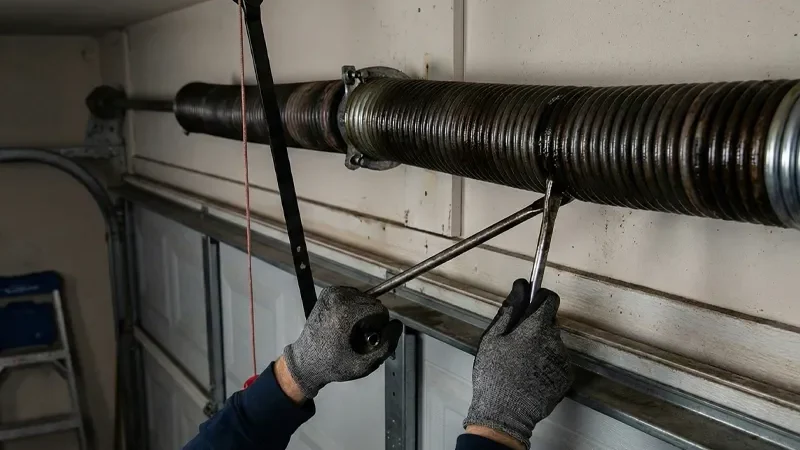
Most homeowners do not realize a garage door spring is failing until the door stops working entirely. By that point, the spring has usually been losing tension for weeks, quietly putting extra strain on the opener motor, cables, and tracks with every cycle. Knowing the early warning signs gives you the window to schedule garage door spring repair before a manageable issue becomes a full system breakdown. The signs are consistent, they show up in a recognizable order, and once you know what to look for they are hard to miss. The visual check from the floor and the manual balance test here are safe steps you can take before calling a professional.
Why Garage Door Springs Fail in the First Place
Torsion springs fail because of cycle fatigue, not because of a single incident. Every time your garage door opens and closes, that counts as one cycle against the spring’s rated lifespan. Standard torsion springs are rated for approximately 10,000 cycles, which works out to roughly seven to nine years for a household using the door three to five times daily. Once a spring approaches that threshold, the metal begins fatiguing from the inside out, losing tension gradually before it gives out completely.
What catches most homeowners off guard is that a spring at 9,800 cycles looks identical to a spring at 1,000 cycles. There is no visible wear on the outside. The coil looks tight, the finish looks clean, and nothing appears wrong until the tension is actually tested. We have arrived at jobs where the homeowner was convinced the opener was the problem, only to find during inspection that the opener was functioning exactly within spec. The spring had simply reached the end of its rated life.
In the Inland Empire, heat cycling accelerates this process. The temperature swing between a cool San Bernardino morning and peak afternoon heat causes the spring metal to expand and contract repeatedly, compounding cycle fatigue faster than most manufacturers’ standard ratings account for. We use powder-coated high-cycle torsion springs as our standard replacement because the powder coating seals the metal surface against moisture intrusion, the primary driver of stress corrosion cracking in torsion springs. California state contractor licensing requirements govern which companies can legally service these load-bearing components, and working with a licensed garage door company ensures the repair is handled by technicians who meet those standards.
The Door Feels Heavier Than It Used to
A properly balanced garage door should feel close to weightless when lifted manually. The springs counterbalance nearly the full weight of the door, which on a standard two-car insulated steel door typically falls between 180 and 250 pounds depending on panel thickness and insulation rating. Disconnect the opener, lift the door to the halfway point, and release it. A door in balance holds its position. A door with weakening springs drops toward the ground.
When we test a spring nearing the end of its cycle life, there is a particular looseness in how the door responds during this balance check. A spring with healthy tension holds the door firmly at the halfway point with almost no drift. A spring close to failure lets the door drift downward slowly before settling. That drift tells us more about remaining spring life than a visual check ever could.
We have pulled up to service calls where homeowners had already called an electrician assuming the opener was losing power. The opener was working fine. The spring had been losing tension for weeks, the door had gradually gotten heavier, and the opener was straining to compensate. Catching the spring early would have been a single straightforward repair. Catching it late meant addressing two components instead of one.
The Opener Struggles or Strains During Operation
Garage door openers are sized and calibrated for a balanced door, not for lifting without spring support. The motor’s duty cycle, meaning how hard and how long it can run before generating excessive heat, is calculated assuming the springs are doing their share of the work. When spring tension drops, the opener carries a load it was never rated to handle and the motor duty cycle shortens dramatically.
The symptoms are a louder or more strained motor, a door that opens more slowly, or an opener that hesitates at the start of the cycle. A pattern we encounter regularly is homeowners scheduling what they believe is an opener repair and describing exactly these symptoms. On inspection the opener tests within its normal operating parameters. The spring is the root cause, and once it is replaced the opener returns to normal operation without any additional work.
You Can See a Gap or Separation in the Spring Coil
A broken torsion spring is sometimes visible from the garage floor. A healthy spring has tightly wound, evenly spaced coils along its full length. A broken spring shows a clear gap, typically an inch or more of open space where the metal has separated under tension. The gap is usually visible when looking up toward the shaft mounted above the center of the garage door opening. This visual check from the floor is a safe step you can take before making the service call.
What matters is what not to do next. Do not lift the door manually beyond a few inches and do not run the opener through repeated cycles. Even a broken spring retains residual tension that requires proper winding bars and professional training to handle safely. The visual confirmation from the floor is enough. The next step is a service call, not a closer look.
The Door Reverses, Stops, or Won’t Open at All
Modern garage door openers include a safety reverse function that stops and reverses the door when the motor detects resistance beyond a calibrated threshold. When a spring loses enough tension, the door becomes heavy enough that the opener registers the extra load as an obstruction and triggers the reverse mid-cycle.
The door starts to open, stops, and reverses. These symptoms send most homeowners straight to the safety sensors, cleaning lenses and checking alignment. We have inspected many doors where the sensors were in perfect working condition and the opener kept reversing anyway, because spring tension was so far gone that door weight alone was exceeding the opener’s resistance threshold. The sensors were doing exactly what they were supposed to do. The spring was the problem.
Why a Professional Inspection Finds What You Cannot See
Visual checks from the garage floor catch the obvious failures. They do not catch a spring at 9,500 cycles with no visible damage that is two weeks from snapping. They do not catch unequal tension between two springs in a dual system where both coils look intact. And they do not catch early cable fraying and drum wear a weakening spring causes before any other symptom becomes noticeable.
A complete professional inspection tests the door’s balance under load, measures spring tension directly, inspects the cable drums and winding cones, and evaluates the surrounding hardware. At Reveille Garage Door Service, every inspection is completed by our own licensed team under California state licensing requirements, not outside subcontractors. We use higher-cycle powder-coated torsion springs as our standard replacement. The International Door Association recognizes higher-cycle spring ratings as a meaningful durability standard, and it is the standard we build every repair around.
What Happens When You Wait Too Long
A spring showing early failure signs but still functioning creates a false sense of security. What is happening underneath is a cascade of strain spreading through the system with every cycle. The opener motor wears faster. The cables absorb uneven loads and begin to fray at the drum. The tracks shift under the stress of an unbalanced door. A repair that would have been a single component replacement becomes a multi-component job.
The most serious consequence is a door that falls without warning. A torsion spring that snaps while the door is in motion removes the counterbalance instantly. A residential garage door weighing between 180 and 250 pounds dropping without control is not a theoretical risk. It is the reason garage door spring repair should be scheduled at the first sign of trouble rather than monitored and delayed.
Schedule Garage Door Spring Repair With Reveille Garage Door Service
If your garage door is showing any of the signs covered in this article, a professional inspection is the right next step. Reveille Garage Door Service is a licensed garage door company serving homeowners across Southern California, Texas, and nearby areas. Our team brings more than ten years of hands-on industry experience, uses higher-cycle powder-coated torsion springs built for the demands of the Inland Empire climate, and completes every job with our own licensed technicians rather than outside subcontractors. Every repair is backed by extended warranty protection on parts and labor.
Reach out to Reveille Garage Door Service today and have your garage door spring inspected by professionals who know exactly how to fix it right the first time.