
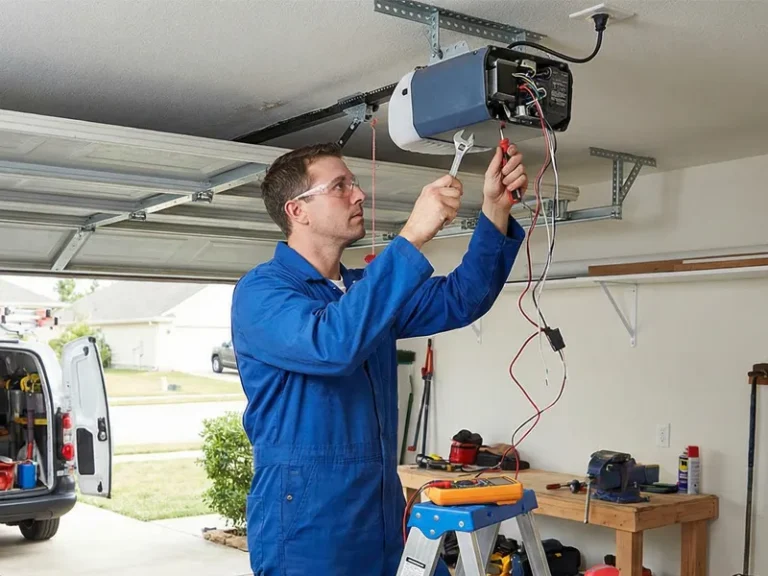
Garage door opener installation cost is shaped by more than the price tag on the unit itself. The opener model is only one variable in a list that includes door weight, drive type, electrical readiness at the site, smart features, spring compatibility, and ceiling clearance. Homeowners who understand what actually drives the total cost are better positioned to evaluate quotes accurately, avoid surprises on installation day, and choose an opener that performs reliably for years rather than one that sounds like a deal until the motor burns out two years ahead of schedule. This article walks through every factor that affects the cost so you go into the process with the right expectations.
Door Weight and Size Determine the Opener You Actually Need
Opener horsepower is not a preference. It is a specification matched to door weight, and getting it wrong at the selection stage is one of the most common and most avoidable sources of premature opener failure. A standard non-insulated single-car door typically requires one-third to one-half horsepower to operate within the motor’s rated duty cycle. A two-car insulated steel door in the 200 to 250-pound range requires three-quarter to one horsepower to lift reliably without the motor running hot on every cycle.
We have replaced openers that were less than three years old because the unit selected at purchase was undersized for the door it was asked to run. The motor ran loud and slow from the first week, the homeowner assumed it was normal, and by the time they called for service the motor windings had deteriorated from sustained overload. Matching horsepower to door weight at the point of selection is not an upsell. It is the core specification the entire installation is built around.
The Drive Type You Choose Affects Installation and Daily Operation
Garage door openers are available in three primary drive configurations, and each one carries a different price point, installation requirement, and long-term performance profile. Chain drive units are the most economical option and the most widely installed, but they produce the most vibration and mechanical noise during operation. In a detached garage that is not adjacent to living spaces, that trade-off is usually acceptable. In an attached garage with a bedroom or living room on the other side of the wall, the noise difference between a chain drive and a belt drive unit is noticeable on day one.
Belt drive openers run significantly quieter because the reinforced belt eliminates the metal-on-metal contact that produces chain drive vibration. The daily performance difference in an attached garage is one of the most consistent things homeowners mention after the fact. Screw drive openers require less routine maintenance than either chain or belt systems but perform inconsistently in climates with significant temperature swings. In the Inland Empire, where the gap between a January morning and a July afternoon can exceed 50 degrees, screw drive units tend to slow down or bind in cold conditions and run rough in peak heat. Belt drive handles that temperature range more consistently.
Electrical Readiness at the Installation Site
California state electrical requirements for garage door opener installation include a dedicated 120-volt outlet positioned within six feet of the motor unit. When that outlet exists and is compliant, the installation proceeds without additional electrical work. When it does not, the outlet needs to be added before the opener can be installed to code, and that work adds both cost and time to the visit.
A significant number of older homes in the San Bernardino area do not have a compliant outlet in the correct location. The garage may have an outlet on the far wall but nothing within reach of the opener position above the door. We identify this during the initial site assessment before any installation work begins so the homeowner is not hearing about it after the opener is already partially mounted.
Smart Features and Connectivity Options
Modern garage door openers have moved well beyond a basic motor and remote. Rolling code technology, which generates a new encrypted access code with every single use, is now a standard feature on most mid-range and premium opener models. Unlike fixed-code systems used in older openers, rolling code technology prevents code-grabbing, where a bad actor records your remote signal and replays it later. That security standard is recognized across the industry.
WiFi-enabled openers add smartphone remote access, real-time open and close alerts, and integration with smart home systems. Battery backup units keep the door operational during a power outage, which in the Inland Empire becomes relevant during the summer months when grid demand occasionally causes brief outages. The cost difference between a base model and a smart-enabled unit with battery backup is modest relative to the daily convenience and security value those features deliver.
Compatibility With the Existing Garage Door System
A garage door opener does not function in isolation. It operates as part of a system that includes the springs, cables, rollers, tracks, and trolley rail, and every one of those components needs to be in acceptable condition for the new opener to perform correctly. An opener installed on a door with springs near the end of their cycle life strains against added resistance from day one, and both the motor and the aging springs wear faster as a result.
We conduct a full system inspection before completing any opener installation because the condition of the surrounding hardware directly affects how the new unit performs. On a recent installation visit, the door looked and operated normally from the outside but the spring inspection revealed both torsion springs were within an estimated few hundred cycles of their rated limit. Replacing the springs during the same visit prevented a return call within months and protected the new opener from running against a failing spring system from day one.
Trolley Rail Length and Ceiling Clearance Requirements
Ceiling height and available headroom above the door in the open position determine which opener models and rail configurations are physically compatible with the space. Standard trolley rail configurations require a minimum of ten to twelve inches of headroom above the door when it is fully open. Garages with lower ceilings require a low-clearance adapter kit or a different rail configuration, both of which add cost and limit compatible opener models.
High-lift configurations for garages with taller-than-standard ceilings require extended rail sections and specific cable drum setups to handle the additional travel distance. Identifying ceiling clearance and headroom availability during the site assessment prevents the wrong opener from being ordered before the incompatibility is discovered.
Why Licensed Professional Opener Installation Matters
Mounting the motor unit to the ceiling is the visible part of a garage door opener installation. The parts that protect the homeowner’s investment happen before and after that step. A licensed installation includes a spring compatibility check, force limit calibration matched to door weight, safety reverse testing under load, sensor alignment, and a final operational run confirming the system performs correctly. California state contractor licensing requirements exist because force limit errors and spring incompatibility issues create real safety risks that an unlicensed installer may not be trained to identify.
At Reveille Garage Door Service, every opener installation is completed by our own licensed team under California state licensing requirements. We do not use subcontractors. The International Door Association sets recognized standards for opener installation safety compliance and force limit calibration, and those standards are what every installation we complete is measured against. Every job is backed by extended warranty protection covering both parts and labor, which means the installation is something we stand behind after we leave the driveway.
How to Plan for the Real Cost of Garage Door Opener Installation
The most reliable way to approach opener installation cost is to start with an in-person site assessment rather than a phone quote built on assumptions. Door weight, electrical readiness, ceiling clearance, spring condition, and drive type compatibility all affect the final number in ways that a model number and a garage size cannot fully capture. A quote that does not account for electrical work, spring condition, or opener compatibility with the door weight will be revised on installation day. Knowing what the job involves before committing is the clearest path to an installation that stays on budget.
Schedule Garage Door Opener Installation With Reveille Garage Door Service
When you are ready to move forward with a garage door opener installation, working with a licensed professional from the start is what protects the investment. Reveille Garage Door Service serves homeowners across Southern California, Texas, and nearby areas with more than ten years of hands-on industry experience, a licensed team that handles every job without outside subcontractors, and higher-grade components built for long-term performance in the Inland Empire climate.
Reach out to Reveille Garage Door Service today and get an in-person assessment from a team that will give you an accurate picture of what your opener installation actually involves before any work begins.