
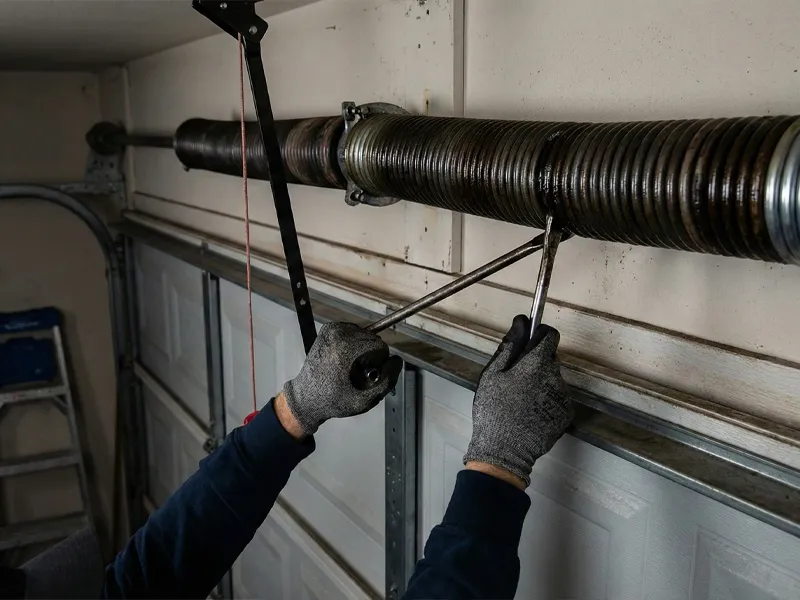
Garage door spring repair cost is determined by more than the price of a replacement spring. The total is shaped by the type of spring your door uses, the door weight and size, whether your system runs one spring or two, the condition of surrounding components, and whether the issue is caught early or after complete failure. Homeowners who understand what drives the cost are better positioned to evaluate quotes accurately and protect their system over the long run.
The Type of Spring Your Door Uses Affects the Cost
Garage doors use one of two spring configurations, and each one carries a different repair profile. Torsion springs are mounted horizontally above the garage door opening on a steel shaft, storing energy by winding under tension and releasing it in a controlled arc to lift and lower the door. Replacing one requires winding bars, a properly rated winding cone, and the trained technique to release and apply tension without losing control of the stored energy in the coil.
Extension springs run along the horizontal tracks on either side of the door and are more common on lighter doors and older systems. They still require professional handling because of the tension involved during replacement.
What affects cost on either system is the spring specification. Wire diameter, inside diameter, and coil length all factor into which spring is correct for a given door. A spring wound to the wrong specification will underperform or overstress during operation, shortening its service life and placing uneven load on the cables and drums. Mismatched specifications from a previous handyman repair are one of the more consistent findings on doors that have had prior non-professional service. California contractor licensing requirements exist in part because spring specification errors carry real mechanical and safety consequences that an untrained installer may not recognize until the failure happens.
Door Size and Weight Drive the Spring Specification
The spring specification required for any garage door is determined by the weight it needs to counterbalance. A standard non-insulated single-car steel door and a fully insulated two-car steel door require completely different spring specifications despite potentially looking similar from the outside. The heavier door needs a spring wound to a higher torque output to provide the counterbalance force that makes the door feel close to weightless during a manual lift.
This is why phone quotes that skip door size, material, and insulation level are the quotes most likely to change on service day. The spring specification cannot be confirmed without knowing what it is being asked to lift, and sourcing the correct replacement after arrival adds time and cost that a proper upfront assessment would have avoided. We have arrived at jobs where the spring ordered from a phone description was wound for a lighter door than what was installed, requiring the correct spring to be sourced before any repair work could begin.
Single Spring vs Dual Spring Systems and Why It Matters for Cost
Most residential garage doors use a dual-spring torsion system, with two springs sharing the lifting load equally. When one breaks, whether to replace one or both is a conversation we have on nearly every two-spring service call.
Both springs in a dual system have completed the same number of cycles since installation. Standard torsion springs are rated for approximately 10,000 cycles. If one has reached that threshold and failed, the surviving spring is almost always within a few hundred cycles of the same limit. Replacing only the broken spring saves money on the current visit and creates a near-certain return call within months.
Replacing both springs in one visit costs more upfront and significantly less over the period when the second service call, labor, and parts are factored into the comparison.
The Condition of Surrounding Components Affects the Total
A spring weakening over weeks does not fail in isolation. The opener motor compensates for lost counterbalance by running harder than its rated duty cycle. The cables absorb uneven tension as spring force drops. The drums wind and unwind under conditions they were not sized to handle.
By the time the spring snaps and the homeowner calls, the inspection often reveals cable fraying, drum wear, or opener strain that developed while the door was running on a failing spring. The most common source of a higher-than-expected repair bill is not the spring itself. It is the secondary wear that accumulated while warning signs were ignored.
A repair call at the first sign of trouble almost always stays within a narrow scope. The same call after complete failure routinely involves evaluating three or four components instead of one.
Standard Springs vs Higher-Cycle Springs and the Long-Term Cost Difference
The spring used in a repair directly affects how long it lasts and what it costs over time. Standard torsion springs are rated for approximately 10,000 cycles, translating to seven to nine years at three to five cycles per day. That figure is a starting point, not a guarantee, because environmental conditions accelerate the timeline.
In the Inland Empire, temperature cycling between cool mornings and peak afternoon heat compounds cycle fatigue faster than the rated lifespan accounts for. Moisture exposure drives stress corrosion cracking in the spring wire, causing failure ahead of the rated cycle count. Higher-cycle powder-coated torsion springs address both failure modes. The powder coating seals the metal surface against moisture intrusion, and the higher cycle rating means the spring handles more total load before the metal begins to fatigue.
The International Door Association recognizes higher-cycle spring ratings as a meaningful durability standard, and it is the specification we use as our baseline on every repair.
Why the Labor Cost in Spring Repair Reflects Real Skill and Safety Requirements
Replacing a torsion spring requires winding bars sized to the winding cone, a controlled technique for releasing existing tension safely, and the training to wind the replacement to the correct tension for the door weight. A technician without proper winding bars and a rated winding cone is handling stored mechanical energy at a level that causes serious injury when something goes wrong.
California contractor licensing requirements for garage door work exist because spring handling carries genuine safety risk without proper training and equipment. An unlicensed operator cutting price on spring repair is almost always cutting the safety margin built into the process.
What a Complete Spring Repair Visit Actually Includes
A professional spring repair visit begins with a full system inspection identifying which spring has failed, the condition of remaining springs on a dual system, and what wear has accumulated on the cables, drums, and opener while the failing spring was placing extra load on the system.
The technician releases remaining tension, removes the damaged spring, and installs the replacement wound to the correct specification. Balance testing confirms the door holds at the halfway point without drifting. Opener force calibration is adjusted to match the newly balanced door. A new spring at correct tension changes the resistance profile the opener was previously calibrated against, and skipping that step leaves the opener running on settings that no longer match the system it is lifting. A final operational run confirms the complete system is functioning correctly.
At Reveille Garage Door Service, every spring repair is completed by our own licensed team, not outside subcontractors. We use higher-cycle powder-coated torsion springs as our standard replacement component, and every repair is backed by a minimum one-year parts and labor warranty with extended parts coverage available depending on the specific repair performed.
Why Acting Early on Spring Repair Keeps the Cost Lower
The most cost-effective spring repair call is the one that happens before the door stops working entirely. A spring showing early warning signs, a door that feels heavier than it used to, an opener that hesitates or strains at the start of the lift, a subtle tilt during opening on a dual-spring system, can almost always be addressed as a single-component repair with a narrow scope and a predictable cost.
A spring that has snapped and been run on for days brings a different picture to the inspection. The opener has been cycling against dead weight. The cables have been under uneven load. What should have been a spring replacement becomes a system evaluation with multiple components in question. Every warning sign a garage door spring sends before complete failure is an opportunity to keep that from happening.
Schedule Garage Door Spring Repair With Reveille Garage Door Service
If your garage door spring is showing early signs of wear or has already failed, professional service from a licensed team is the right next step. Reveille Garage Door Service serves homeowners across Southern California, Texas, and nearby areas with more than ten years of hands-on industry experience, higher-cycle powder-coated torsion springs built for the Inland Empire climate, and a licensed team that completes every repair without outside subcontractors. Every repair is backed by a minimum one-year parts and labor warranty with extended parts coverage depending on the repair. Reach out to Reveille Garage Door Service today and have your spring inspected and repaired by professionals committed to getting it right the first time.