
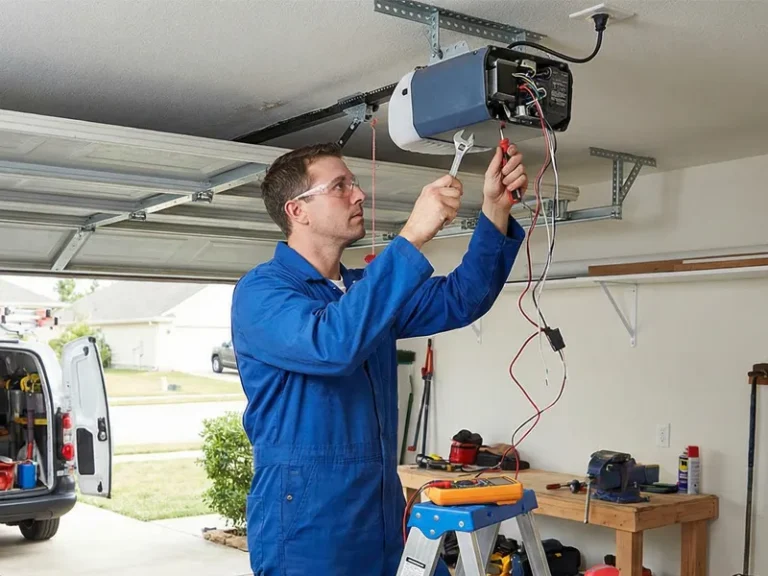
A garage door opener usually signals the need for repair well before it stops working entirely. The warning signs show up gradually, a hesitation at startup, a new sound during the lift cycle, a door that reverses when it should not, and most homeowners learn to work around them rather than act on them. Knowing what to look for and when those signs cross the line from minor quirk to a real garage door opener repair gives you the window to act before a full breakdown.
The Opener Responds Slowly or Takes Longer to Start
A delay between pressing the remote and the opener engaging is one of the earlier and more treatable warning signs of opener deterioration. When that response slows to a one or two second hesitation before the door begins moving, the motor or its starting components are signaling that something has changed.
The motor capacitor is the component responsible for providing the initial electrical surge that starts the motor on each cycle. A capacitor that is losing capacity causes the motor to hesitate before engaging, run sluggishly through the lift cycle, or fail to start at all on the first attempt. This is one of the most consistently dismissed symptoms we see. Homeowners working with an older opener assume the delay is simply how it behaves as it ages. What it actually represents is a component trending toward failure. Catching it early is significantly less involved than addressing it after the motor stops responding.
The Opener Makes Grinding, Clicking, or Straining Sounds
Unusual sounds from a garage door opener are not quirks to adapt to. Grinding during the lift cycle almost always points to worn drive gears or a gear assembly that has partially stripped. It is the sound of metal engaging incorrectly, and it gets louder as the damage progresses.
Clicking without movement, where the opener audibly attempts to engage but the door does not respond, typically points to a failing motor capacitor that is no longer producing the surge needed to start the motor. Straining or labored motor sounds during the lift cycle point to the opener running outside its rated duty cycle. The duty cycle is the ratio of running time to rest time the motor is designed to sustain without overheating. When the door is heavier than the opener’s rated capacity, or when the springs have lost tension and are no longer providing adequate counterbalance, the motor compensates by working harder on every cycle. Grinding tends to get noticed and then tolerated longer than it should be because the door keeps functioning. By the time the gear strips completely, the homeowner has usually been hearing it for weeks.
The Door Reverses Before It Closes or Opens Fully
A door that reverses without completing the cycle is one of the more frustrating opener symptoms and one of the most commonly misdiagnosed. Most homeowners check the safety sensors first, which is reasonable. The photo-eye sensors mounted near the floor on either side of the door operate on an infrared beam. When that beam is interrupted or misaligned by even a few degrees, the opener’s safety circuit prevents the door from closing.
When the sensors check out, the next place to look is the travel limit settings. These settings define how far the door moves in each direction before the motor stops. When they drift out of calibration, the opener reverses before the door reaches the fully closed or fully open position, or strains against the floor or header at the end of travel. Correcting travel limit settings requires the opener’s internal adjustment process rather than a sensor cleaning. Force settings that interpret normal door resistance as an obstruction are another cause of the same symptom. All three fall within the scope of what a professional inspection covers.
The Opener Works Intermittently Without a Clear Pattern
Intermittent opener behavior is one of the harder symptoms to describe and one of the more telling ones diagnostically. The door works fine for several cycles, refuses to respond for no apparent reason, then works again. Remote batteries are fresh, sensors are clear, the wall switch works. The opener just refuses on certain cycles.
Modern openers using rolling code technology generate a new encrypted access code with every use, which means they are not susceptible to the signal interference that affects older fixed-code systems. When a rolling code opener behaves intermittently, the fault is almost always inside the unit itself, a failing logic board or a wiring connection that is degrading under repeated heat cycling. In the Inland Empire, where attached garages reach significant temperatures during summer months, logic boards and wiring connections degrade faster than in climate-controlled spaces. The symptoms appear and disappear as components heat up and cool down, which is why the behavior seems random when it is actually temperature-driven.
The Opener Activates Without Any Input
A garage door that opens or closes on its own warrants prompt attention for both mechanical and security reasons. Modern openers using rolling code technology are not susceptible to signal capture or interference from neighboring remotes. When a unit using this system activates without input, the cause is almost always a stuck or short-circuiting remote button, a wiring fault in the wall switch circuit, or a logic board fault.
Older fixed-code openers are more vulnerable to interference from neighboring systems or radio frequency sources. Before calling for service, check the remotes for stuck buttons and inspect the wall switch for visible wiring damage. If neither produces an explanation, the fault is inside the opener and requires a professional inspection.
The Opener Runs but the Door Does Not Move
When the opener motor engages and runs through its normal cycle but the door stays in place, the mechanical connection between the motor and the door has been interrupted somewhere. The most common and most easily resolved cause is the trolley being in manual release mode. The red release cord hanging from the trolley rail is designed to be pulled during a power outage so the door can be operated by hand. Homeowners who pull it and forget to re-engage the trolley are often surprised to find the opener running a full cycle without moving the door at all. Re-engaging the trolley by pulling the release cord back toward the motor resolves this immediately.
When the trolley is confirmed engaged and the door still does not move, the fault is in the drive system. A stripped gear assembly, a broken drive belt, or a failed chain are all mechanical failures that require component replacement by a trained technician.
The Wall Switch Works but the Remote Does Not or Vice Versa
Isolating the symptom to either the remote or the wall switch is one of the most useful steps a homeowner can take before calling for service. When the wall switch works but the remote does not, the fault is in the remote, its frequency, or signal reception at the opener’s antenna. Antenna signal issues are more common in San Bernardino area garages than homeowners expect because the metal framing in some residential structures reduces signal range between the remote and the opener unit.
When the remote works but the wall switch does not, the fault is in the wall switch wiring or the switch itself. Both scenarios give the technician a clear starting point before the inspection begins.
When to Call a Licensed Technician for Garage Door Opener Repair
Some steps in this article are safe for a homeowner to perform before scheduling service, including checking remote batteries, cleaning the photo-eye sensor lenses, confirming the trolley is engaged, and checking the wall switch for visible wiring damage. Beyond those steps, opener repair requires proper training and equipment.
Opener force calibration, internal component replacement, and logic board diagnosis require a technician who understands how these systems interact. California contractor licensing requirements for garage door work exist because improper force calibration and internal component errors create real safety risks on residential systems. The International Door Association sets recognized standards for opener force calibration that licensed professionals are trained to meet.
At Reveille Garage Door Service, every opener repair is completed by our own licensed team under California state licensing requirements, not outside subcontractors. We bring more than ten years of hands-on industry experience to every inspection and every repair, and every job is backed by our minimum one-year parts and labor warranty.
Schedule Garage Door Opener Repair With Reveille Garage Door Service
If your garage door opener is showing any of the signs covered in this article, a professional inspection is the right next step. Reveille Garage Door Service is a licensed garage door company serving homeowners across Southern California, Texas, and nearby areas. Our team handles every opener repair with our own licensed employees, uses higher-grade components built for long-term performance, and stands behind every repair with a minimum one-year parts and labor warranty. Reach out to Reveille Garage Door Service today and have your opener inspected by professionals who will tell you exactly what is wrong and why before any work begins.