
A west-facing garage door can absorb hours of afternoon sun. By early evening, the garage may feel like an oven, and some of that heat can move toward a bedroom, kitchen, or hallway that shares a wall with it.
That is why the choice between insulated vs. non-insulated garage doors is about more than winter weather. In San Bernardino and nearby Inland Empire communities, insulation can affect garage comfort, heat flow, noise, door strength, and purchase price.
Reveille Garage Door Service installs residential doors from CHI Doors, Amarr, Clopay, and Martin Door. This guide explains how to compare the full door rather than choosing by one number on a brochure.
The Short Answer: Insulated vs. Non-Insulated Garage Doors
When comparing insulated vs. non-insulated garage doors, choose an insulated model if your garage is attached, faces strong afternoon sun, sits below a living space, serves as a workshop, or requires sound dampening. A non-insulated door can make sense for a detached garage used strictly for parking or cold storage when keeping upfront costs low is your primary goal.
Insulation does not turn a garage into conditioned living space. Gaps around the perimeter, windows, thin walls, an uninsulated ceiling, and frequent door openings can still let heat move in and out.
The best choice comes from looking at the door construction, tested thermal rating, seals, windows, exposure, garage use, and budget together.
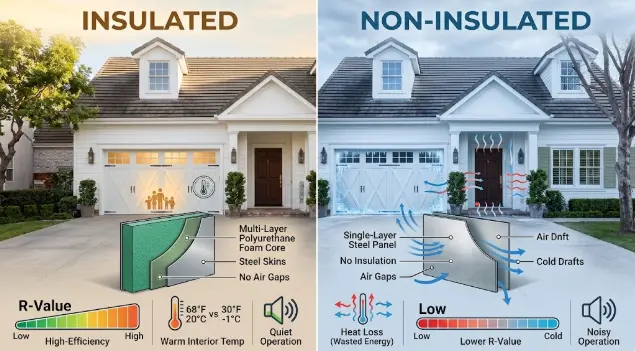
What Garage Door Insulation Actually Does
Most residential sectional garage doors use one, two, or three main layers. The layer count affects thermal performance, stiffness, interior appearance, and price.
Single-Layer Doors
A basic non-insulated steel door usually has one exterior steel skin supported by the section frame. The interior face remains open, so you can often see the stiles and reinforcement.
This design is light and usually costs less. It provides little resistance to heat moving through the door panel and may flex more than a multi-layer door.
Two-Layer Doors
A two-layer door adds insulation to the back of the exterior skin. The insulation may remain visible from inside the garage, depending on the product.
This design can reduce heat transfer and sound without reaching the price of a fully finished three-layer door. The exposed interior surface may be easier to mark or damage during storage and daily use.
Three-Layer Doors
A three-layer door places insulation between exterior and interior skins. This sandwich construction usually creates a cleaner interior face and a stiffer section.
A stronger panel can feel more solid during operation and resist ordinary dents or flexing better, but construction varies by model. Steel thickness, reinforcement, section design, and hardware still matter.
R-Value vs. U-Factor
R-value measures resistance to heat flow. A higher R-value means greater resistance, and the Federal Trade Commission requires many home-insulation claims to follow its R-Value Rule.
U-factor measures how quickly heat passes through an assembly. A lower U-factor is better, which is the opposite direction from R-value.
The Door & Access Systems Manufacturers Association explains that a garage door’s R-value may describe insulation at the center of a panel, while U-factor can evaluate heat transfer through the complete door assembly. That whole-door view can include sections, joints, framing, and other paths where heat moves more easily.
Do not compare two doors by R-value alone unless the manufacturers use the same test method and report the same part of the product. Ask whether the number is a tested whole-door value, a calculated panel value, or only the insulation material’s rating.
A high panel R-value cannot cancel a large gap under the door. Bottom seals, perimeter weatherstripping, section joints, glass, and the fit of the installed door all affect real performance.
Why Attached Garages Change the Decision
An attached garage shares part of the home’s building envelope. It may share a wall with a kitchen or family room, sit under a bedroom, or connect to a hallway through an entry door.
In that layout, the garage door is one large exterior surface. Slowing heat flow through it can help moderate garage temperature, which may reduce the temperature difference across the surfaces shared with the home.
Insulation may also help when someone works on hobbies, exercises, does laundry, or stores temperature-sensitive items in the garage. It will not make those uses safe or code-compliant as living space, but it can make short periods in the garage more comfortable.
A detached garage used only for vehicles and durable storage has fewer reasons to protect indoor comfort. If nobody spends time there and it shares no surfaces with the house, paying for a high thermal rating may offer limited value.
Hot Inland Southern California Conditions
San Bernardino, Redlands, Rancho Cucamonga, Fontana, and Riverside experience much hotter inland conditions than coastal Southern California. Direct sun on a large metal door can add to the heat already entering through the roof and walls.
Orientation matters. A west-facing door receives intense late-day sun, while a shaded north-facing door may have a smaller heat load. Dark colors tend to become hotter in sun than lighter finishes, so color belongs in the thermal discussion too.
An insulated door can slow heat passing through the panels, but it cannot remove heat already in the garage. Roof insulation, attic ventilation, air sealing, shade, and safe ventilation may matter just as much.
DASMA warns that thermal performance depends on more than the advertised insulation value and that air leakage can be a major part of the result. A well-fitted moderate-rated door may perform better in daily use than a high-rated panel installed with poor seals.
Other Benefits Beyond Temperature
Insulation adds mass and support between door skins. That can reduce the hollow, rattling sound associated with a basic single-layer steel door.
The difference is useful when a bedroom is above the garage or the opener runs early in the morning. Rollers, hinges, track alignment, and opener condition also affect noise, so insulation is not the only answer.
Multi-layer construction can make sections feel more rigid. This can help with normal flexing, but no residential door is damage-proof, and insulation does not replace proper reinforcement or maintenance.
The finished interior skin on many three-layer doors is also easier to wipe clean and looks more complete. That may matter in a garage used as an organized workspace or a main household entry.
When Insulation May Not Be Worth It
A non-insulated door is often a reasonable choice when all of these are true:
- The garage is detached from the home.
- It is used mainly for parking or basic storage.
- Nobody spends long periods inside.
- The door is shaded or has limited afternoon exposure.
- Lowest initial cost is the main goal.
- The rest of the garage has little or no insulation.
Spending heavily on the door may not solve comfort problems if the garage roof, walls, windows, and side door leak far more heat. Start with the whole space and the way you use it.
A rental, planned near-term sale, or rarely used outbuilding may also call for a simpler product. The right decision is the one that fits the house, not the door with the largest number.
Materials, Windows, and Door Design
Steel doors offer a broad range of styles, insulation levels, colors, and prices. Many insulated models use polystyrene panels or polyurethane foam between steel skins.
Polyurethane commonly fills more of the interior cavity and bonds to the skins, which can add stiffness. Polystyrene is often supplied as fitted rigid panels and may be a lower-cost insulated option.
Wood has natural insulating ability, but species, thickness, panel construction, moisture protection, and maintenance needs vary. A wood-look steel door can provide a different balance of appearance, upkeep, and thermal performance.
Windows reduce the area available for insulated panel construction. Insulated glass can improve a window section, but glass and its frame may still transfer more heat than the surrounding panel.
Large doors also need suitable reinforcement, springs, tracks, and an opener matched to the completed door. If a heavier replacement changes the system requirements, include those needs in the complete proposal instead of comparing panel prices alone.
How to Compare Garage Door Quotes
Start with the same size, style, color, window design, and hardware package. Then compare construction and thermal information line by line.
Ask each provider these questions:
- Is the door single-, double-, or triple-layer construction?
- What insulation type and thickness does it use?
- Is the listed R-value for the insulation, panel center, or whole door?
- Is a tested whole-door U-factor available?
- What bottom seal and perimeter weatherstripping are included?
- Do windows change the thermal rating?
- Are tracks, springs, reinforcement, removal, and disposal included?
- Will the existing opener suit the new door’s size and weight?
The installation itself matters. The door should fit the opening, travel correctly, seal as well as the floor and framing allow, and operate as a balanced system.
Reveille’s garage door installation service can help homeowners compare residential options without treating the most expensive door as the automatic answer. If the existing door may still have useful life, start with garage door repair instead of assuming replacement is required.
Plan for the Door and Opener Together
A replacement door does not always require a new opener. The opener’s age, condition, lifting capacity, rail length, controls, and compatibility with the door all matter.
The springs counterbalance the door’s weight, so the opener should guide a properly balanced door rather than lift dead weight. Never adjust or replace high-tension springs or cables yourself.
If the opener is unreliable or mismatched, review garage door opener installation at the same time. Coordinating both decisions can prevent a new door from being paired with worn or unsuitable equipment.
Cost: Use National Figures as Context Only
Installed cost changes with door size, construction, insulation, steel thickness, windows, finish, hardware, site conditions, removal, and opener work. A custom wood design can sit far above a basic single-car steel door.
For broad national planning, a fetched 2026 consumer cost guide places residential garage door replacement at about $700 to $3,500 on average, depending on door size, style, material, and features. This is a national market range, not a Reveille quote, and it should not be used as a promise of local pricing.
For a noncommercial benchmark, the National Association of Realtors and National Association of the Remodeling Industry reported a $2,000 national project-cost estimate for a new garage door in their 2022 Remodeling Impact Report. That older single estimate sits within the planning range but does not capture every current product or installation.
The useful comparison is the complete installed scope. Get a written local proposal that identifies the exact door, insulation, glass, finish, hardware, removal, and any opener changes.
A Practical Decision Checklist
Choose an insulated door when several of these statements apply:
- The garage is attached or below a room.
- The door faces west or receives long hours of direct sun.
- People use the garage as a workshop, gym, laundry area, or hobby space.
- Quieter operation and a finished interior matter.
- The home will likely be kept long enough to value daily comfort.
- The garage walls and ceiling are already insulated or will be improved.
Choose a non-insulated door when the garage is detached, lightly used, shaded, and mainly protects vehicles or basic storage. It is also reasonable when budget needs to go first toward structural repairs, safe operation, roof insulation, or better perimeter sealing.
For help in San Bernardino and nearby service areas, Reveille Garage Door Service is available 24/7 for standard residential garage door services. The goal is to “help you out with your garage door at your house” and explain which features fit the way you actually use the space.
Frequently Asked Questions
Are Insulated Garage Doors Worth It in Southern California?
They often are for attached garages, west-facing doors, rooms above the garage, and spaces used for projects or exercise. Coastal-style assumptions do not fit every Inland Empire home because direct sun and inland heat can make the garage much hotter.
What Is a Good R-Value for a Garage Door?
There is no single best number for every house. Compare ratings made with the same method, then weigh whole-door U-factor, seals, windows, exposure, and garage use rather than chasing the highest R-value.
Does an Insulated Garage Door Keep the Garage Cool?
It slows heat transfer through the door panels, but it does not actively cool the space. The roof, walls, air leaks, sunlight, ventilation, and how often the door opens still affect garage temperature.
How Much Does an Insulated Garage Door Cost?
A broad 2026 national planning range for residential garage door replacement is about $700 to $3,500, depending on size, style, material, and features. This is not a Reveille quote; local price also depends on construction, windows, finish, hardware, removal, and opener needs.
Is an Insulated Door Quieter?
Often, yes. Added layers can reduce hollow panel vibration, but worn rollers, loose hardware, track problems, and the opener may still create noise.
Can I Add Insulation to My Existing Garage Door?
Some doors can accept approved retrofit kits, but added weight and thickness can affect balance, hardware, clearance, and operation. Have the door evaluated first, and do not alter springs or cables yourself.
Do I Need a New Opener With an Insulated Door?
Not always. A properly selected spring system carries the door’s weight, but the opener must still be compatible with the door, rail, controls, and installation.
Get Help Comparing Residential Garage Doors
Reveille Garage Door Service serves homeowners in San Bernardino, Redlands, Rancho Cucamonga, Fontana, and Riverside. The company works with residential doors from CHI Doors, Amarr, Clopay, and Martin Door.
Call (909) 359-6799 or contact Reveille Garage Door Service to discuss an installation at your home. Reveille is available 24/7 and is located at 4130 Hallmark Pkwy Unit A, San Bernardino, CA 92407.